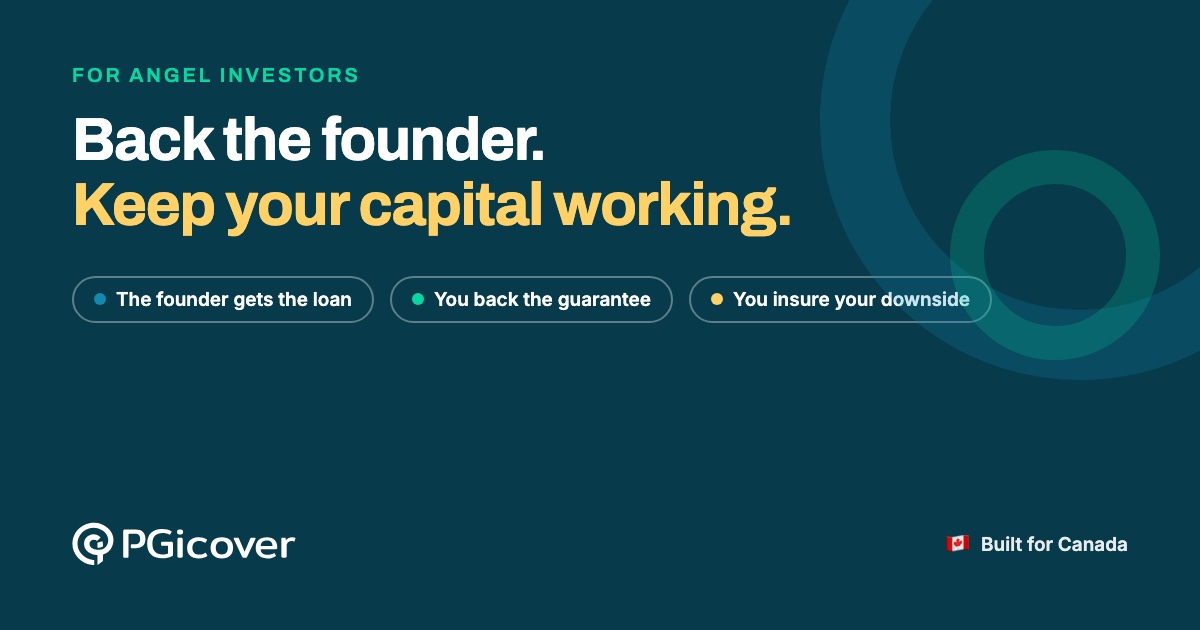
An angel investor does not always have to write the whole cheque. Backing a founder's personal guarantee, and insuring it, can free up capital for other opportunities.
Quick answer. An angel investor does not always have to write the whole cheque. If a young founder can qualify for a business loan but the lender wants a personal guarantee, an experienced investor may be able to provide that guarantee as a director of the company. Personal Guarantee Insurance can then reimburse part of what the guarantor pays if the guarantee is ever enforced, subject to policy terms. The founder gets the capital. The investor keeps more of their own cash free for other opportunities.
What if you could support a founder without tying up all your capital?
Young entrepreneurs often have good ideas, real skills and the drive to build something.
But when they apply for financing, many hit the same wall. The lender asks for a personal guarantee.
For a founder with few assets and a short credit history, that one requirement can end the conversation.
This creates an opening for angel investors.
Instead of providing all the capital yourself, you may be able to help the founder reach a business loan by backing the guarantee, and use Personal Guarantee Insurance as part of how you manage that risk.
Doing more with the same capital
Traditional angel investing means writing a cheque.
You might put $100,000 into a young company in exchange for equity. Once that money is in, it is committed to that one business.
There is another way to help.
If the founder qualifies for a loan but needs a guarantor, an experienced investor can sometimes fill that role. Personal Guarantee Insurance can reimburse the guarantor for part of a covered loss, subject to eligibility, underwriting and the policy terms.
That is a different kind of leverage. Your balance sheet does the work, and your cash stays available.
More leverage can mean more opportunities
Capital is limited, even for successful investors.
You may want to back young companies and still have room for:
- Other startup investments
- Investment properties
- Other operating businesses
- A diversified portfolio
Helping a founder reach commercial financing, rather than funding everything yourself, can leave you that room.
This does not remove risk. A personal guarantee is a serious commitment. If the business fails, the lender can come to you.
More leverage also means more exposure, not less. The goal is not to take on more risk for its own sake. The goal is to use your capital and your financial strength more efficiently, with your eyes open.
Supporting founders without removing the incentive
There is a second advantage to a loan.
Equity money and borrowed money feel very different to the person spending them.
A loan creates an obligation. It has to be repaid, on a schedule. That tends to focus a founder on:
- Finding customers
- Generating revenue
- Managing expenses
- Building steady cash flow
- Reaching profit
The founder knows the business has to perform.
Debt can encourage discipline
Debt is not right for every business or every founder.
But where there is a realistic path to revenue and the loan can be serviced, borrowing can build good habits early.
The founder has a clear job: build the business, earn revenue, make a profit, repay the loan.
That lines the founder up with what a business is for in the first place.
A possible win for both sides
For the entrepreneur
- Access to business financing
- More capital to grow
- A chance to build a credit history
- More ownership kept, and more independence
- A strong reason to reach revenue and profit
For the angel investor
- More efficient use of available capital
- More flexibility
- Room to pursue other opportunities
- A way to support a founder without providing all the money directly
How it could work
Picture a young entrepreneur with a strong plan.
They need $100,000 for equipment, inventory, staff or expansion.
Instead of asking you for the full amount, they apply to a lender.
The lender requires a personal guarantee. You join the company as a director and provide it.
You insure that guarantee with Personal Guarantee Insurance.
The founder receives the capital. You have not written a $100,000 cheque. And the founder has every reason to make the business work, because the loan has to be repaid.
What you need to know before you sign
This part matters more than the rest.
- Cover is for directors. Personal Guarantee Insurance is written for a director of the borrowing company who has signed the guarantee. It ends if that person stops being a director. An investor who is not a director should not assume they qualify. Ask first.
- It is partial. The policy reimburses a share of the loss, not all of it. You keep part of the risk.
- It is not a fast pay. Payment comes only after the company's insolvency process has finished and the lender has made its final settlement request.
- It must be active. A claim counts only if it is made and reported while the policy is in force, with premiums paid.
- It pays you, not the lender. Your guarantee and the lender's rights stay exactly as they are.
- It does not stop a business from failing. It limits what that failure costs you personally.
- Where and how much. Available to directors of private Canadian companies outside Quebec, on guarantees of $50,000 or more.
Do your own due diligence on the founder and the business, as you would for any investment.
Two questions instead of one
Direct equity investing will always have a place. It is often the right tool.
It is not the only one.
Most investors ask one question: how much should I invest in this founder?
There is a second question worth asking: how can I help this founder reach the capital they need, and still keep my own capital flexible?
The bottom line
Angel investors have more than one way to support entrepreneurship.
You can invest directly. You can take equity. And in the right circumstances, you can help a founder reach a business loan.
Backing the guarantee, and insuring it, may give you more flexibility and better use of your capital.
The founder gets financing. You keep room for other investments. And the founder has a strong reason to build a profitable business, because the loan has to be repaid.
Support entrepreneurs. Preserve capital. Stay flexible.
See where a guarantee would stand in about ten minutes with an instant pre-approval at app.pgicover.com. For anything else, reach PGicover through the contact page at pgicover.com/contact.
Before you sign any guarantee, read our checklist of questions to ask before you close.
Personal Guarantee Insurance is subject to eligibility, underwriting, policy terms, conditions and exclusions. Providing a personal guarantee involves financial risk. This article is for general information only and is not legal, financial, investment, lending or insurance advice.